
Tennessee basketball opened its season with a 90-59 win over Wofford.
The Vols needed a half to find their offensive rhythm, relying on Tyler Lundblade’s perimeter shooting to remain competitive early. But after halftime, improved ball movement and execution helped Tennessee pull away, offering an early glimpse of the potential that comes with its top-10 ranking.
Here are three takeaways from Tennessee’s season-opening win.
Searching for Structure
Tennessee’s roster turnover was evident in its offensive execution in the first half. With an almost entirely new group entering the 2026 season, the Vols struggled to establish rhythm and structure in the half-court. Players frequently occupied the same space, and several possessions devolved into individual efforts rather than a cohesive offensive attack.
One possession with 8:24 remaining in the first half encapsulated those struggles. Tennessee generated little movement during the first 15 seconds of the shot clock, eventually leaving Miles Rubin stranded at the free-throw line without a clear passing option. With the possession breaking down, Rubin forced a pass that Wofford intercepted, leading to a Cam Lowe layup at the other end.

There were, however, flashes of what Tennessee’s offense could look like with better execution. Following a pair of Wofford free throws, the Vols ran their best action of the half, using a Spain pick-and-roll to free Rubin near the basket for a right-handed layup. It was a glimpse of the offense’s potential when players executed with purpose and used screening actions to create advantages.
Finding Offensive Flow
Tennessee’s offensive execution improved considerably coming out of the break. The Vols opened the second half with an 18-2 run, fueled by better ball movement and more purposeful off-ball activity. Players made timely cuts and set screens to create opportunities for one another instead of relying on individual shot creation.
On the opening possession, DeWayne Brown cut behind the defense, drawing attention before finding Rubin for a dunk. The possession illustrated how off-ball movement can disrupt defensive positioning and create opportunities for teammates.
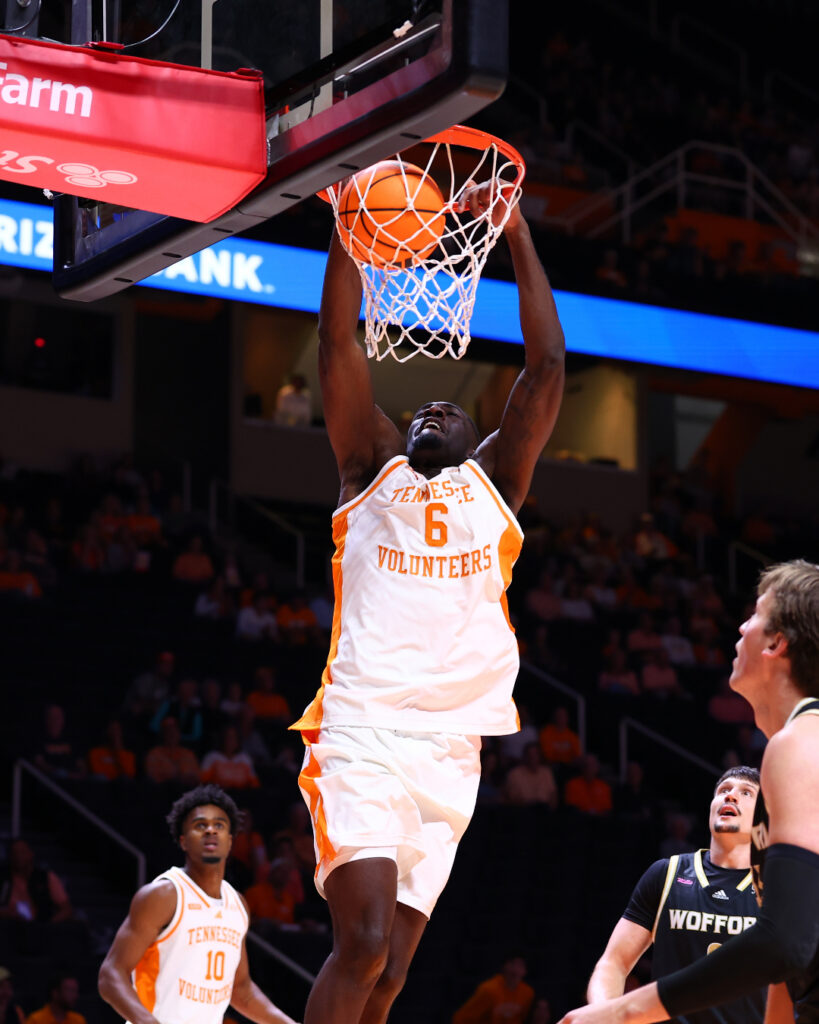
Some of Tennessee’s offensive growing pains are understandable given the roster turnover, but the second-half surge offered an encouraging glimpse of the team’s potential. The Vols have the offensive talent to create problems for opposing defenses. Developing the chemistry and discipline to sustain that execution over 40 minutes will determine how quickly the Vols reach their offensive potential.
A Perimeter Presence
Despite Tennessee’s early offensive struggles, Tyler Lundblade helped keep the Vols afloat with his perimeter shooting.
The senior showed why Tennessee made him its first transfer portal addition this offseason. Lundblade has a natural feel for finding open space and getting his shot off, finishing with 12 points, all from beyond the arc.

Lundblade’s ability to work off screens makes him an interesting offensive weapon. Rather than needing the ball in his hands to create scoring opportunities, he can use off-ball movement to put pressure on opposing defenses. His connection with Miles Rubin is particularly worth watching. Nine of Lundblade’s points came off Rubin’s screens, offering an early glimpse of how the two could complement each other offensively.
Lundblade demonstrated that versatility throughout the first half. His first basket came off a Rubin flare screen, while his next three 3-pointers came after working off pindown screens. The variety of actions gives Tennessee different ways to get Lundblade open and makes the Rubin-Lundblade combination one worth monitoring as the season progresses.
As the game progressed, Tennessee’s offense began to find the rhythm Lundblade provided early. The Vols finished shooting 52.3% from the field, a sign of the improvement they showed after halftime. With two more buy games before facing Michigan State on Nov. 17, Tennessee has an opportunity to continue building its offensive chemistry before the schedule gets more demanding.