
The frustration was visible on the court, and afterward, it was spelled out plainly by those inside the program.
After leading for all but the final 34 seconds, the Vols unraveled defensively, failed to rebound with force, and turned the ball over in critical moments, allowing Kentucky to escape Food City Center with an 80-78 win.
Tennessee has not beaten the Wildcats at home since Feb. 15, 2022, and Saturday followed a familiar script.
“I’m disappointed. Everybody’s disappointed, but gotta give Kentucky credit,” Tennessee coach Rick Barnes said.
Barnes pointed first to defense and effort, particularly late, where he felt experience and toughness were missing. He compared the current roster to past Tennessee teams built around players like Zakai Zeigler, Jahmai Mashack, and John Fulkerson, groups that relied less on talent and more on discipline and physicality.
“No doubt those guys win these games because they’re not going to collapse on defense like that,” Barnes said. “Those guys weren’t nearly as talented as these guys are, obviously, but at the end of the game, they still win by taking care of the ball and getting stops.”
This Tennessee team did neither consistently in the second half. Kentucky shot 6-for-10 from three after halftime, repeatedly taking advantage of overaggressive closeouts that opened driving lanes. The Wildcats also dominated the glass late, pulling down 13 offensive rebounds in the second half alone.
“We won a lot of games here being competitive, tough, hard-nosed defensive teams,” Barnes said.
Turnovers compounded the issue. Tennessee committed seven after halftime, including the decisive one in the final minute. With less than 40 seconds left and the Vols clinging to a one-point lead, Ja’Kobi Gillespie threw a pass that Kentucky intercepted, turning it into a fast-break basket that swung the game.
“I thought Nate was open, and he wasn’t, and I threw it,” Gillespie said. “I shouldn’t have done that. So, yeah, this is a bad decision.”
Gillespie finished with a team-high 24 points and was Tennessee’s most consistent offensive option, but he acknowledged the breakdowns began immediately after halftime.
“We just gave them too many easy ones coming out the half,” he said.
Barnes said inconsistency has been the most frustrating part of the season, especially from players with significant collegiate experience.
“Our guys work hard. They do work hard,” Barnes said. “But there’s more to it. The mental side of it’s just as important.”
Freshman Nate Ament was even more direct when asked about Kentucky’s rebounding dominance.
“It’s hard to really give an answer for that besides just lack of effort,” Ament said. “Not being physical enough, not wanting to win the game as bad as they did.”
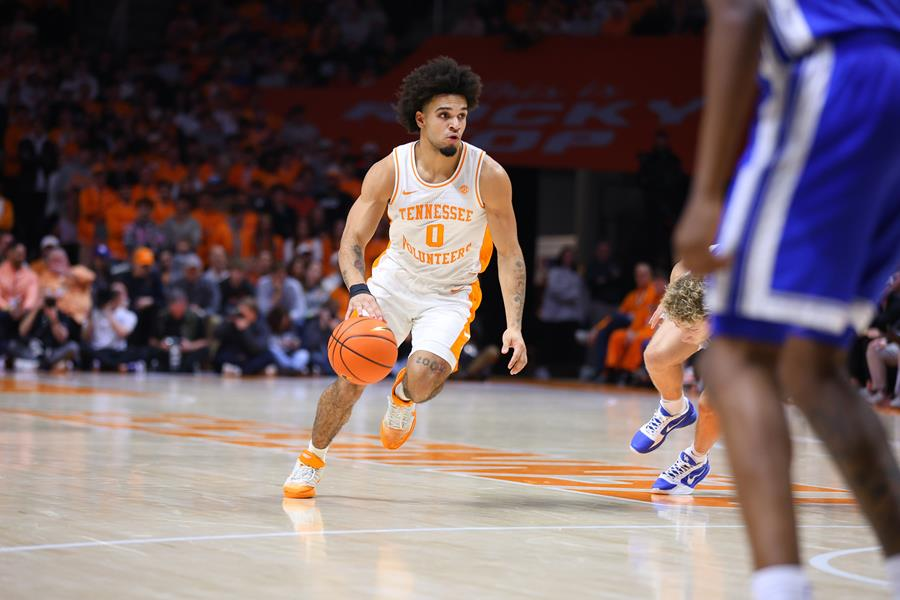
Ament did not deflect responsibility, pointing to his own play as part of the issue.
“I can look back to a couple, if not more possessions where I didn’t give the best effort I should,” he said. “You give Kentucky credit for crashing the glass hard and really wanting to win that game.”
As for why effort lapses continue to surface, Ament pointed to comfort and complacency.
“I think we can get comfortable,” he said. “Sometimes we get a big lead, we get comfortable, we start settling. That can happen, especially with new players who maybe don’t fully understand the culture.”
Ament said there is no longer an excuse.
“We’ve had enough time to understand what Tennessee basketball is,” he said. “If you don’t want to feel this again, then we’ve got to give a better effort.”
For Ament, the loss carried added weight because of the rivalry and the home crowd.
“I just know our fans wanted this one bad,” he said. “It sucks to let the fans down.”
Gillespie echoed that the issue is mental as much as physical.
“We’ve got to play with the same edge the whole game,” he said. “We can’t relax when we get up 10 or 15. You’ve got to want to win way more than they want to win.”
Until Tennessee does that consistently, close games like Saturday’s may continue to slip away.